Capacity
A slot holds 64. What changes that number sits on the tab hanging off the left edge of the screen, and counts for the whole crate wherever it is put.
The tab and its cells
The tab is a column, not a fixed pair. The mod ships two cells: the top one takes a capacity module, the one under it a stack of sixteen row modules. Another mod can add its own and the tab grows with it. An empty cell shows a greyed plate, so it reads as what it is waiting for.
What it costs
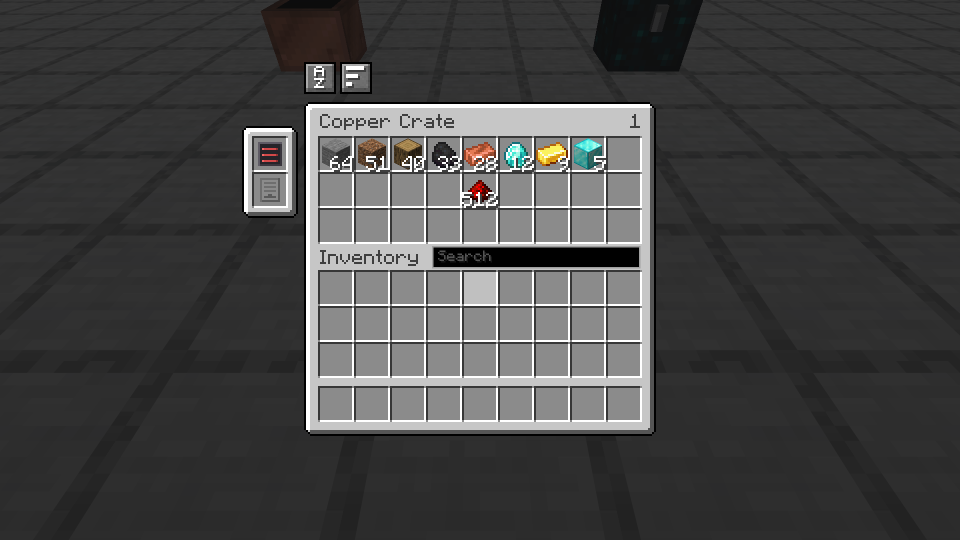
Pull the module out, close the screen, and everything above the new capacity drops on the ground in one tick. A full double echo crate losing its 512 module empties 1,008 stacks at once, and nobody picks that up before it despawns. Empty the crate before taking the module back.
The strongest offer, not the sum
Which cell an item sits in no longer decides what it does. A capacity module raises the whole crate from any cell, and the crate takes the strongest offer: two 256 modules still give 256, a 256 next to a 512 gives 512. Rows follow the opposite rule and add up, which is the one difference between the two families.
Why 512 and no further
The three shipped modules stop at 512 by choice, not by capability. A slot goes up to 32,767 and a module from another mod may ask for that number. The ceiling belongs to the menu: the current capacity reaches the client through a packet that writes a short, and the save file is bounded by the same number.
A slot's count travels as a variable-length integer, so a large number costs nothing on the wire. What shapes it is the game's own save format, which refuses any count above 99: a crate therefore writes its slots in a format of its own, the item on one side and its count on the other.
What a hand can carry
None of this changes what a player moves around. A hand, a hopper stack and a dropped item are still 64, so taking from a crate hands out one ordinary stack at a time.