The six crates
Six tiers, each nine slots deeper than the one before, and each made by surrounding that crate with the material the next one is named after.
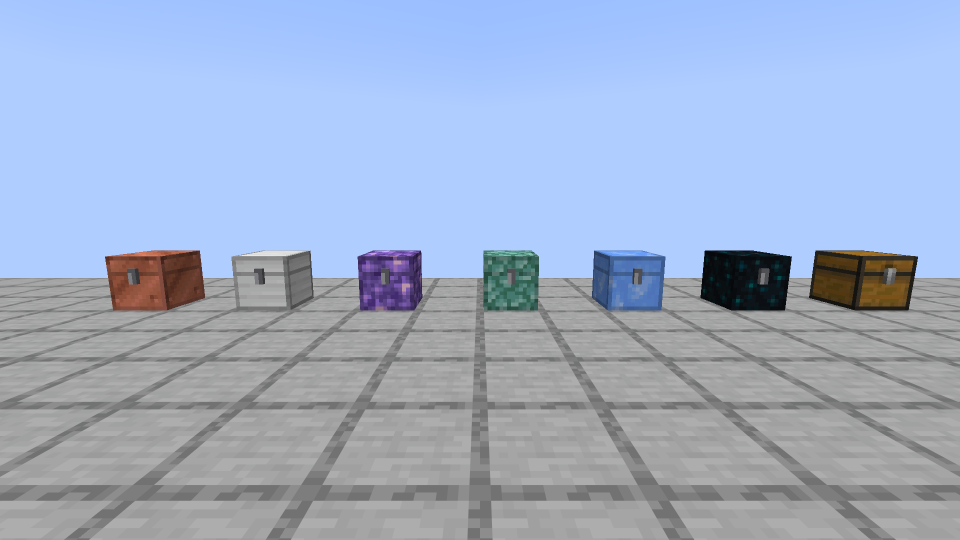
The table
| Crate | Around the one before | Slots |
|---|---|---|
| Copper | copper ingot, around a copper chest | 27 |
| Iron | iron ingot | 36 |
| Amethyst | amethyst shard | 45 |
| Prismarine | prismarine crystals | 54 |
| Breeze | breeze rod | 63 |
| Echo | echo shard | 72 |
The order follows how hard the material is to reach, which is what puts breeze and echo at the top: one comes out of a trial chamber, the other out of an ancient city.
Two crates that marry
Two crates of the same tier placed side by side open one screen, as chests of the game do. The slots of the two halves run on without a seam, sorting treats them as a single series, and the two share one module: whatever sits on one half's tab counts for the whole pair.
A pair of echo crates therefore holds 144 slots, and 432 with sixteen row modules in. Two different tiers side by side stay two separate crates.
What a crate keeps of its name
A crate renamed on an anvil keeps that name once placed, and the screen prints it top left. A name wider than the room it has is cut short before the page number rather than drawn over it.
Breaking a crate
A broken crate hands its contents back on the ground, cut into stacks of 64, because that is all an item entity knows how to carry. A full echo crate returns a great many at once, and none of it waits five minutes for you.